Showing posts with label feminism. Show all posts

Sunday, April 27, 2014

I Need Feminism Because

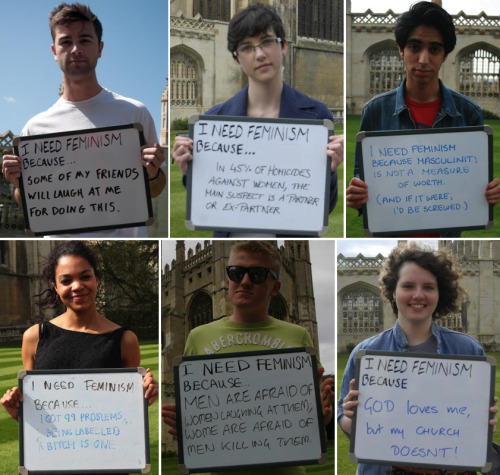
Anyone who's been spending a good deal of time on the internet (or, at least, most of the corners of the internet I tend to frequent) has probably seen the "I need feminism because..." meme. It's pretty fantastic, really, with some really amazing, illustrative reasons for why this movement exists. The photograph ones are especially poignant:


But today I want to share my own personal notes after something that happened on Purdue's campus. Walking back from a theater performance, I was getting nervous because it was dark and (once I passed Heavilon) I was alone. To make things even worse, it was raining and I'd actually taken off my glasses because I could see better without them than I could with them getting rain-speckled (...which is to say, I couldn't see at all, but at least there were recognizable shapes). 

As I got to a darker part of campus (across from one of the frat houses, which only aggravated my nervousness), I found myself walking behind two older men. They were obviously middle aged, and obviously (from their conversation) coming from the same show I'd just seen. All in all, they were pretty unthreatening. So, when it became obvious we were heading in the same direction, I confirmed that they were, in fact, heading to the same parking garage.

Me: "Oh, great! I really hate walking alone after dark."
Guy: "Of course. You can join us. Our wives (who were walking about a block behind, chatting) won't mind."

....and then he tried to put his arm around me. 

I'd like to say he meant it as a protective gesture, but he very obviously didn't (his tone was highly suggestive, if only jokingly) and, regardless, it was a completely inappropriate move. I'd just expressed the fact that I was feeling vulnerable. The last thing I wanted was to be touched, and he was the last person who would have had the right.

Nothing happened. I say this to reassure friends and family, rather than to dismiss how much this bothered me. We walked to the garage in an awkward gaggle, I quickly got in my car, and I drove home. The end. But it's been two days and I can't forget it.

I also can't forget the fact that, as the rain started, I had the thought that "Well, I should be safer now, because no one is going to want to assault someone in this...."

....I need feminism, because I shouldn't have to tell someone to keep their hands to themselves when
  1. They are a stranger
  2. I am vulnerable
  3. I have blatantly said I feel worried about being victimized
I need feminism, because I shouldn't have to factor weather systems into my ability to walk safely.

I need feminism, because so many women are not as lucky as me and have had to deal with more than an inappropriate side-hug.

And I need feminism, because I'm sitting here, getting ready to post this, and wondering whether it will be seen as overreacting.

But I'm posting it anyway.


Thursday, September 19, 2013

From a Peacemaker...or why compromise isn't always the right answer.

Dear Well-Meaning, Respectful, Socially-Conscious Sir:

We're friends. Or we're friends of friends. You're the kind of guy who cares about people as people. You are considerate and intelligent. You care about social injustices, and you genuinely want to have honest and frank discussions.

I want you to know that I respect you. And I know that you respect me. I enjoy the conversations we have, and I welcome the questions you bring to me. And so I hope that you will indulge me as I give a layered response to a concern that keeps coming up in our conversations...

This is a concern over the tone of arguments for feminism and women's rights. It's the doubt that you voice about the effectiveness of confrontation. You know that violence and inequality exist and you think they're important issues, but you question whether loud exclamations of "RAPE CULTURE" and "MISOGYNY" are more detrimental than helpful. After all, when everyone starts shouting at each other, how is anyone supposed to actually hear each other?

As a rhetorician and an incorrigible peacemaker, this is a concern I understand well. I value conversation over confrontation and--like you--I'm quick to advise that people aim for a middle ground and communication rather than an ideological throw-down. When I teach my students about effective arguments, we talk about issues like addressing both sides, seeking compromise and affirming multiple points of view. So I'm not disagreeing with you, by any means. At least...........not here.

But (and here's my compromise), I want to talk about why you're maybe (completely unintentionally) missing the point when you ask "angry" or "confrontational" feminists to "tone it down" in the name of productive conversation.

When I teach argument to my students, one of the first things we consider is how our approach changes, depending on who the audience is. And we talk about how, often, the audience that is verbally addressed isn't the actual audience. (Think of any political campaign that attacks the opposing party. That's not a message meant to change minds...it's a message meant to rally existing supporters.) And while "preaching to the choir" often has a negative connotation, it can serve a very important purpose.

In the case of marginalization and oppression, these vocal, seemingly one-sided exclamations give a very clear, very necessary message: "You are not alone."

It's a well documented issue that victims of oppression don't talk about what they've gone through. There are a lot of reasons for this. One of the largest issues is that, in order to victimize someone, an assailant (physical or otherwise) has to deprive the victim of power. They make them feel weak. Alone. Once this has happened, reclaiming that power can be incredibly difficult (and can feel impossible). And it's not just about the "strength" or "will" of the victim. Society itself often continues the process that the assailant began. This is because the arguments used by assailants aren't new...they're simply extreme versions of things we hear everyday. So when a victim tries to speak up, they now have to speak up against their attacker, their trauma, and a society that's often unwilling to listen. No wonder they're so silent.

When a group takes up a cause of marginalization, they are confrontational. Often times, this confrontation falls into anger and belligerence, which is very upsetting and off-putting to the well-meaning, respectful, socially conscious people they are addressing. After all, these are rational, empathetic individuals who would never intentionally victimize someone else, nor condone that behavior from someone else. They feel attacked. They feel blamed. And this, like you've voiced, is not a good starting place for meaningful discussion.

But what I'd like you to realize, when you come to me and say "I know violence towards women is a problem, but..." or "I know racism still exists, but..." you're actually pointing out exactly why this kind of communication IS valid. Is important. Is vital.

YOU know that these inequalities exist, but the victims of these crimes often don't. They have been isolated. They have been stripped of power and agency and community and support.

You hear angry voices, but they hear a rallying cry.

You see a fruitless endeavor, but they see a community.

You're right, you know. If things are going to change, we need communication. We need compromise and understanding and intelligent discussion. But in order for that to happen, there is a whole community out there that needs to get its voice back. They need to be able to safely and securely join the conversation because, until that happens, a large part of society is going to continue reinforcing all the lies their assailants forced on them.

Yes, extreme voices are angry. Yes, they are often just noise...sound and fury and raw emotion. And to you, that's upsetting and unhelpful.

But to people who have spent years in silence, that noise is exactly what they need.

Friday, September 13, 2013

Sexual Choice...what freedom of choice should mean.

There is a lot that's been said about feminism and sexuality. It's a heated argument on both sides, from women's right to control their sexual health and the way they express their sexuality to the fear that this demand has led to the sexual exploitation of women.

In many ways, I side with feminism and its painfully simple (and yet often denied) truth that a woman's worth is not defined by her sexuality or what she does with it. This is not meant as an attack towards anyone who values conservative values, but rather it's an attack on the idea that sexual exploration (even--or especially--when it's a bad idea) "corrupts" or "pollutes" a woman. This mindset is often the product of slut-shaming, a double standard that links the value of a woman to her "purity"...which often means that those who express themselves outside of this value are seen as lesser. Other.

There are plenty of articles out there talking about why this is a bad ideology, and how slut-shaming leads to the perpetuation of our current rape culture. I think those are important articles. They're necessary. They're timely (the Miley Cyrus uproar, anyone?).

They are not this blog.

I don't disagree that public opinion is still often skewed towards objectification and dehumanization of women (yes, ladies and gents...when you place a woman's value entirely in her sexuality--rather than her characteristics as a person--you are practicing dehumanization). But this is actually a response to a scathing review of 50 Shades of Grey.

Normally, I am all for scathing reviews when it comes to Twilight or its fanfiction offspring (again, that's another post), but what struck me this time was the author's snidely dismissive comment: "Are we honestly supposed to believe that a 20 year old woman hasn't had sex?"

....Ouch.

There is so much loaded in that question. There's the idea that, if you are 20 or older and are still a virgin, you are "Other." And, like every time we "other" people...there's the implication that if you fit into this "other" category, something must be wrong.

Let's put aside the ideas of repression, religious duty, or political appropriation of sexuality. Let's step back from the (very pressing and real) concerns posed by lack of proper sex education and the prevalence of STDs.

Instead, let's talk about the meaning of the word "choice."

Last time I checked, feminism was all about a woman's right to choose how to express her sexuality. Which means, if she so chooses, she can choose not to have sex.

That's right. A woman has the right to say no to sex. Not on a case by case basis. Not for safety, or for virtue, or because it's the "right" thing to do. Simply because they do.

If we try to define the justifiable reasons a woman has for saying "No," we're limiting her as much as if we define the justifiable reasons she has for saying "Yes."

I do not believe that women need to "save themselves" to be "good," "pure," "holy," "safe," "virtuous," "nice," or "smart." But I also refuse to believe that saying "That's not something I want to do," whether it means right now, in the near future, or ever, is always a sign of being "repressed," "close-minded," "naive," or "controlled."

A woman's sexuality is just that. Hers. Her comfort level is also hers. And she is the only one who has the right to define what she chooses to do with them. Regardless of what that choice is.

Tuesday, August 27, 2013

Before We Reach for the Mute Button...

The recent shock and awe over Miley Cyrus's VMA performance has invoked a lot of strong opinions and vocal protests from a diverse audience. From the news to Twitter to Facebook and back, the reactions have been fast and furious: everything from "Miley can do whatever she wants. STOP TALKING ABOUT IT" to "Is this really what we should be focusing on right now?" to the idea that her scanty outfit and (arguably) outrageous twerking is one of the harbingers of the downfall of civilization.

What happened to our wholesome,
American family values?
Perhaps ironically, a large chunk of the commentary about the event is focusing on the reasons why we shouldn't talk about it. Jezebel had numerous articles speaking out against the slut-shaming* that was happening, defending Cyrus's right as a legal, consenting adult to express her sexuality however she damn well pleases. Meanwhile, enterprising bloggers created a tumblr account devoted to things we should have been paying attention to in Cyrus's stead. And with over 24 hours of non-stop media chatter over the event, more than a few individuals have just about had it. As Toula Foscolos wrote for Huffpost Canada, "Miley's not racist, not a whore, and not your punching bag." Isn't it embarrassing how easily we are caught up in the media hype of pop-culture and titillating, "shock-value" media ploys?

Actually, I'd like to argue that it isn't. At least, not all of it.

Yes, I would prefer it if we (in this case, being the assumed, generalized population of America) were more concerned with world news and the possible threat of a new war. But the fact that we, as an audience, are so obsessed with one twenty-something's performance has a lot to say. About our country. About what we value. And about how that conversation is developing in some fascinating and, I believe, vitally important ways.

For anyone who has been following the "War on Women" over the past few years (okay, centuries, but I'm talking recent legislation), the conversation about women's sexuality, agency, and a push against slut- and victim-shaming is crucial to how we respond to the world around us. As one of my fellow grad students pointed out, it's unlikely that the fallout would have been anything near as absolute if the offender had been, say, Drake or Kanye. Little has been said about Robin Thicke's participation in the duet, except in relation to Cyrus's agency. After all, boys will be boys.

The conversation has also raised up the voices of women of color, as in one black woman's response about how, in their rush to defend her right to her sexuality, white feminists completely ignored the blatant misappropriation of black culture, and the objectification of black, female bodies.

Cyrus's performance has also opened up conversations about any number of non-feminist topics, such as The Onion's bitingly comical summary of the interplay of publicity and "news," the objectification of child and teen stars, and a great deal of commentary and criticism about (what else) Americans' obsession with celebrity gossip.

I'll admit, I'm looking forward to waking up and seeing a stream of posts in my newsfeed that have nothing to do with VMAs, twerking, or the Cyrus family. But however much we want the conversation to change, I think it's important to note that it's these exact, uncomfortable, and seemingly-repetitive conversations that are the foundations of social change.

I doubt that Miley Cyrus's performance is going to bring about sweeping reforms in how we view celebrity, women, or race. But I do believe that, whether anyone intended it or not, she has become part of that discourse...and we do ourselves a disservice if we shut that down.